
Rubio’s Recalibration: Eight Lessons for Europe’s Strategic Future

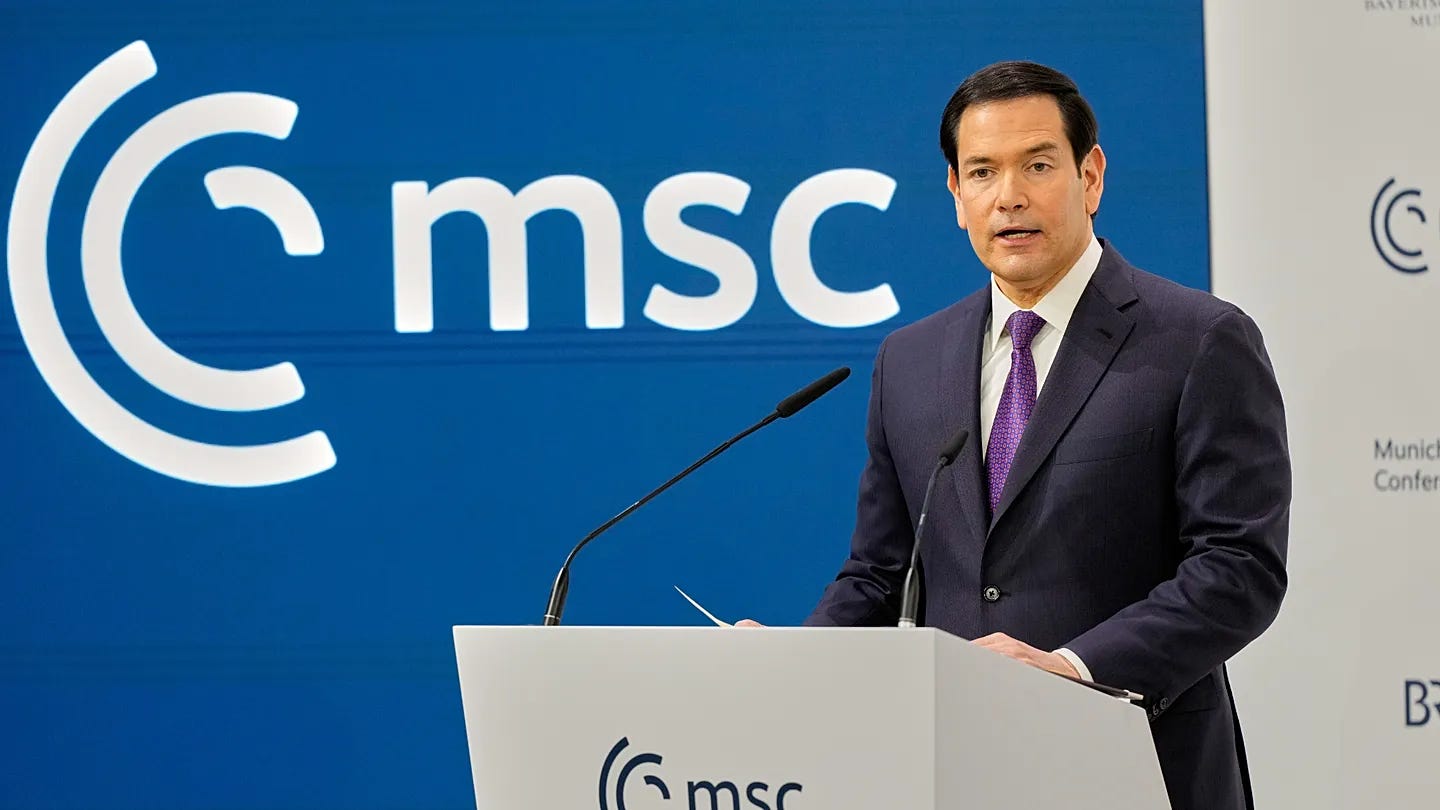
When U.S. Secretary of State Marco Rubio addressed the Munich Security Conference, European officials did not hear rupture.[1] They heard recalibration.
Rubio’s speech was conciliatory in tone. He stressed that Europe and the United States “belong together,” reaffirmed NATO’s importance, and framed Washington’s demands as a call for partnership rather than retrenchment.[2]At the same time, he did not distance himself from President Donald Trump’s rhetoric on Greenland, nor did he dwell on Ukraine or Russia. The message was unmistakable: the alliance endures, but on revised terms.
Much of the European press interpreted the intervention similarly. The applause in Munich appeared to reflect relief more than enthusiasm - relief that the temperature had lowered after months of strain, and that the language of alliance remained intact. But relief should not be confused with strategic reassurance.
Tone and Structure
European reactions revealed this duality. Ursula von der Leyen said she felt reassured. [3] EU foreign policy chief Kaja Kallas suggested Europeans had “breathed a sigh of relief.” [4] Finland’s President Alexander Stubb observed that Rubio had lowered the temperature in the relationship, even if the substance remained largely unchanged. [5]
Others were more cautious. Germany’s defence minister Boris Pistorius warned that questioning NATO members’ territorial integrity and sidelining Europeans in security negotiations risked weakening the alliance. [6] Austrian officials remarked that “in substance nothing changes.” In Paris, policymakers pointed to a widening cultural divergence following tariff threats and criticism of Europe’s regulatory model.[7]
The divergence lies less in rhetoric than in premises. Rubio reiterated themes familiar from Vice President JD Vance: sovereignty, burden-sharing, and scepticism toward what he characterised as ideological excess in the West. The argument is not for withdrawal, but for rebalancing around national interest and strategic competition.
American commentary reflected this framing. Many heard the speech as a straightforward defence of American power -and a clear message that Europe needs to carry more of the load or risk being sidelined. What stood out just as much, though, was what Rubio didn’t say: there was no direct mention of Russia, [8]which only deepened the sense that Washington and European capitals are not fully aligned on how they see the threat landscape.
The language was calmer than before. The underlying shift in direction wasn’t. The structural shift did not.
Sovereignty and the European Dilemma
Rubio’s underlying proposition is that the United States seeks European partners who are confident in their national identities, willing to invest in defence, and prepared to act strategically alongside Washington.
This appeal intersects with a longstanding academic debate about European integration. In the early decades of the European project, integration advanced under what political scientists Leon Lindberg and Stuart Scheingold termed a “permissive consensus” - broad public acquiescence to elite-led deepening of cooperation.[9] That environment has largely given way to what Liesbet Hooghe and Gary Marks later described as “constraining dissensus,” in which integration becomes politically contested and electorally salient.[10]
As Lindberg and Scheingold explain, during the era of “permissive consensus,” Europeans largely accepted elite-led integration without questioning the trade-offs - a context that Rubio’s speech underscores has now shifted.
Yet this creates a structural tension within the European Union. Over the years, more and more decision-making power has moved up to the European level -especially on things like fiscal rules, regulation, and trade. But when it comes to political identity and loyalty, most people still feel that connection at the national level.
As Fritz Scharpf has argued, political systems depend on both “output legitimacy” - effective problem-solving - and “input legitimacy” - democratic authorisation.[11] The EU has often justified its authority through performance. But in a politicised environment, performance alone may not suffice.
Eurobarometer surveys continue to show fluctuating trust in EU institutions and consistently stronger identification with national political systems. [12] European Parliament elections, although turnout rose in 2019 and 2024, historically lag behind national contests in engagement. That imbalance -shared authority at the top, but legitimacy that still lives mainly within nation states - hasn’t really been resolved.
Rubio’s speech in Munich directly relates to this issue. It emphasizes the implications for European policymakers and the lessons that need to be taken into account by Europe, which are critical to resolving the issues of sovereignty, integration, and democracy.
8 Key Lessons for Europe
Here’s what Rubio’s Munich speech really gets at, and why it matters for European policymakers:
1. Remember What You’re Protecting - People don’t fight for abstract principles - they fight for their families, their communities, their way of life. When Europe makes big decisions, it needs to stay rooted in its own history and culture. Know what’s actually at stake.
2. Relief Isn’t Real Strength - Sure, it feels easier when Washington eases up or takes a friendlier approach. But that’s not the same as being strong. Europe still needs real power- in defense, in the economy, in sovereignty-to handle what’s coming, both at home and around the world.
3. Sovereignty Still Matters Most - Depending on open borders, foreign supply chains, or international organizations won’t replace true sovereignty. The European Union should take border control and industrial security seriously if it wants to stay secure.
4. Economic Muscle Means Strategic Freedom - Europe chose to deindustrialize and send key industries overseas. That wasn’t inevitable. Now, if Europe wants real economic and strategic freedom, it needs to rebuild its industrial and tech backbone. That’s the way forward.
5. Allies Must Stand Strong - The U.S. expects partners who are capable, self-reliant, and ready to defend themselves. Strength, not deference or guilt, forms the backbone of a credible alliance.
6. Shared Heritage Shapes Partnership - The shared heritage of Europe and the United States, spanning many centuries of shared history, culture, and values, is just as important to the partnership as military or economic alliances.
7. Leadership Requires Action, Not Just Words - Institutions and treaties are not enough; sometimes, tough decisions must be made to protect citizens and prevent threats. Europe must be ready to take action with its allies.
8. Build the Future Together - The United States can go it alone if necessary, but the path to true success requires working together. Europe must take an active role in building a secure, prosperous, and united Western world. This principle is reflected in the way in which European leaders are responding to the call for a new partnership.
Partnership on Revised Terms
The responses of the Europeans will illustrate the strategic balancing. Italian Prime Minister Giorgia Meloni endorsed stronger European responsibility within NATO while emphasising that “autonomy does not mean separation” from the United States.[13]
Nordic governments and defence officials have emphasised that while Europe must strengthen its conventional forces, it still depends on the U.S. nuclear umbrella for deterrence - a reality underscored by European Commissioner for Defence and Space Andrius Kubilius, who noted that Europeans currently cannot replace American nuclear protection even as they boost their own capabilities.[14]
At the same time, NATO Secretary‑General Mark Rutte has stressed that Europe “can’t defend itself without the U.S.” and that Washington expects Europeans to take on more of the conventional defence burden while maintaining the overarching security guarantee provided by the United States.[15]
U.S. Secretary of State Marco Rubio made clear in Bratislava that Washington seeks European partners who are not just present, but capable and ready to take greater responsibility for their own defence. Speaking with Slovak Prime Minister Robert Fico on Sunday, Slovakia marked the first stop on his central European tour, which continues with a visit to Hungary. While the United States is not withdrawing from Europe, it expects European countries to carry a larger share of the defence burden. [16]
Rubio’s meetings with Slovakia and Hungary also underscore a broader shift in U.S. engagement: Washington increasingly views Europe as a network of sovereign actors rather than dealing exclusively through Brussels. This approach does not diminish the role of the EU, but it does add new layers of complexity to European cohesion.
Legitimacy Before Capability
One year after the warnings delivered at the Munich Security Conference in 2025, Europe can no longer rely on incremental or technical adjustments. American signals of conditional commitment, Russia’s war, and systemic rivalry with China have dispelled any remaining ambiguity: the era of geopolitical naivety is over, and external protection can no longer be taken for granted.
Important steps have been taken. New financial instruments have been created, partnerships diversified, and a collective awareness has begun to take shape. Yet the core challenge remains unresolved. Europe’s test is not merely fiscal or military - it is profoundly political. The task is not simply to raise defence spending, but to rebuild the democratic consent that alone can sustain long-term strategic transformation.
As Peter Mair warned, Western democracies risk becoming systems in which citizens feel “ruled but not represented.” [17] If Europe is to pursue genuine strategic autonomy, it cannot do so over the heads of its citizens or in defiance of them. Decisions on defence, industrial policy, common debt, and trade must be debated, justified, and politically owned. European sovereignty will only be credible abroad if it is legitimate at home.
The transatlantic alliance has not collapsed, but it has evolved. The United States is making clear that its commitment will increasingly depend on European capability and resolve. Softer diplomatic tones may ease tensions temporarily, but they do not alter this structural reality.
The question, then, is no longer whether Europe has awakened, but whether it is ready to mature. Can it translate economic weight into coherent strategy? Can it overcome internal divisions without sacrificing pluralism? Can it defend a distinct model-neither predatory nor naïvely pacifist-in an increasingly competitive international order?
Europe’s future will be decided in the balance between power and legitimacy. If it is to endure without losing itself, it must recognize that power and democracy are not opposing forces, but complementary ones. Only in this way can Europe defend its interests and values, and turn this test of strength into a historic moment of political consolidation.[18]
Photo: Euronews
[1]Secretary Rubio delivers remarks to the Munich Security Conference, available at:
[2]“Rubio tells Europe that US will not abandon transatlantic alliance” available at: https://www.ft.com/content/ad264479-52bb-4a63-bc87-e40d6f0a01c0
[3] “Rubio calls on Europe to join Trump’s new world order” available at: https://www.politico.eu/article/marco-rubio-msc-europe-we-belong-together/
[4] “Europe’s Trump whisperer doesn’t buy US cuddly pivot” available at:
“Security Conference. Kallas: Rubio’s speech gave Europeans a sigh of relief” available at: https://www.repubblica.it/esteri/2026/02/14/diretta/conferenza_monaco_2026_sicurezza_groenlandia_ucraina-425158343/
[5] “Europe’s Trump whisperer doesn’t buy US cuddly pivot” available at:
https://www.politico.eu/article/finland-president-alexander-stubb-us-shift-in-tone-not-substance/
[6]“Defense Secretary Pistorius warns the US against unilateral actions” available at: https://www.zeit.de/politik/ausland/2026-02/muenchner-sicherheitskonferenz-boris-pistorius-usa-nato-vorwurf
[7]“Entre l’Europe et les États-Unis : une Saint-Valentin en trompe-l’œil à Munich” available at: https://www.lepoint.fr/monde/europe-etats-unis-etrange-saint-valentin-a-munich-T6SV7NBLXVGNDESMLQV55L7BZE/
[8] David E. Sanger, “Once the Americans Warned of the Russian Threat. Now, It’s the Europeans’ Turn. In Munich, European leaders were also talking about “de-risking” from the United States, citing President Trump’s unpredictability.” Available at https://www.nytimes.com/2026/02/14/world/europe/europe-munich-rubio-russia.html
[9] Lindberg, Leon N., et Scheingold, Stuart A., Europe’s Would Be Polity. Patterns of Change in the European Community, 1970, Prentice-Hall, 314 p.
[10]Liesbet Hooghe and Gary Marks, “A Postfunctionalist Theory of European Integration: From Permissive Consensus to Constraining Dissensus” B.J.Pol.S. 39, 1–23 Copyright r 2008 Cambridge University Press 27 October 2008
[11] Fritz W. Scharpf, Governing in Europe: Effective and Democratic? (Oxford: Oxford University Press, 1999), pp. 1–19.
[12] https://europa.eu/eurobarometer/surveys/browse/all/series/4961
[13] “Rome, Berlin share pragmatic, non-instinctive approach to US says Meloni” available at: https://www.ansa.it/english/news/2026/01/23/rome-berlin-share-pragmatic-non-instinctive-approach-to-us-says-meloni_e9f6099e-eea4-4de3-84d8-d31c26d8fc21.html?utm_source=chatgpt.com
[14]“Europe can defend itself but cannot replace US nuclear umbrella”, Kubilius tells Euronews available at: https://www.euronews.com/2026/01/28/europe-can-defend-itself-but-cannot-replace-us-nuclear-umbrella-kubilius-tells-euronews
[15] Rudy Ruitenberg, “NATO’s Rutte says Europe can’t defend itself without US; France balks”
available at: https://www.defensenews.com/global/europe/2026/01/27/natos-rutte-says-europe-cant-defend-itself-without-us-france-balks/
[16] “Washington does not need vassals, but strong partners,’ Rubio tells Europe” available at: https://www.euronews.com/my-europe/2026/02/15/washington-does-not-need-vassals-but-strong-partners-rubio-tells-europe?utm_source=chatgpt.com
[17] Peter Mair, “Ruling the Void: The Hollowing of Western Democracy” (London & New York: Verso Books, 2013)
[18] Cristina Vanberghen, “Europe’s Push to ‘Think Big Again’ Is Testing the Limits of Unity” https://moderndiplomacy.eu/2026/02/14/europes-push-to-think-big-again-is-testing-the-limits-of-unity/
Europeans missed how they were invited along for the ride as a passenger. Rubio's speech was like an adult child telling its parents how things are going to run now, that the child is taking over for the weak and aging parent. Rubio even said "America is charting the path for a new century of prosperity, and that once again we want to do it together with you" along with "And while we are prepared, if necessary, to do this alone, it is our preference and it is our hope to do this together with you." In both instances, America is running the show, no negotiations. Rubio also posited it as a direct war against China, which wasn't really noticed...